
Relocating to Puerto Rico: Tax Opportunities and Planning Considerations for High-Net-Worth Individuals
Relocating to Puerto Rico: Tax Opportunities and Planning Considerations for High-Net-Worth Individuals

Puerto Rico continues to attract high-net-worth individuals, entrepreneurs, and investors seeking favorable tax treatment while remaining within the United States. Although the potential tax benefits can be significant, relocating to Puerto Rico requires careful planning to navigate the interaction between U.S. federal and Puerto Rico tax laws.
These opportunities and challenges are among the subjects I examine in the Puerto Rico chapter of the forthcoming book International Relocation and Tax Planning for High-Net-Worth Individuals: A Legal and Lifestyle Guide for Clients and Their Advisors, edited by Jack Bernstein of Aird & Berlis LLP.
Understanding Puerto Rico’s Tax Advantages
Puerto Rico occupies a unique position within the U.S. tax system. Under Section 933 of the Internal Revenue Code, individuals who qualify as bona fide residents of Puerto Rico generally may exclude Puerto Rico-source income from U.S. federal income taxation.
Puerto Rico also offers tax incentives under Act 60-2019, commonly known as the Puerto Rico Incentives Code. Qualifying individuals may benefit from exemptions on certain interest, dividends, and capital gains. Eligible businesses providing services to customers outside Puerto Rico may qualify for a 4% corporate income tax rate and exemptions on qualifying distributions.
These benefits, however, are neither automatic nor universal. Their availability depends on the individual’s residency, the source and character of the income, and compliance with applicable requirements.
Establishing Residency and Managing IRS Scrutiny
A central consideration for individuals relocating to Puerto Rico is establishing and maintaining bona fide residency under U.S. federal tax law.
The applicable rules generally require satisfying three tests: physical presence, tax home, and closer connection to Puerto Rico. Merely purchasing a residence or obtaining a Puerto Rico tax incentives decree does not establish bona fide residency for federal tax purposes.
The IRS has increased its scrutiny of taxpayers claiming Puerto Rico tax benefits, particularly regarding residency, income sourcing, and compliance with applicable federal reporting obligations.
Individuals contemplating relocation should therefore evaluate their circumstances before moving and maintain contemporaneous documentation supporting their residency and tax positions.
Looking Beyond Tax Benefits
Successful relocation involves more than tax planning. Individuals and families must also consider business operations, estate planning, banking, housing, education, healthcare, and other practical aspects of establishing a life in Puerto Rico.
As discussed in my contribution to International Relocation and Tax Planning for High-Net-Worth Individuals, Puerto Rico offers a distinctive combination of tax opportunities, U.S. legal protections, and lifestyle advantages. Realizing those benefits requires a coordinated approach that addresses both the legal requirements and practical realities of relocation.
For individuals considering Puerto Rico, early planning and ongoing compliance are essential to achieving sustainable tax benefits and minimizing the risk of future disputes with tax authorities.
How Procopio Can Help
Relocating to Puerto Rico presents significant opportunities, but realizing the potential tax benefits requires careful planning and an understanding of complex federal and Puerto Rico tax laws. Procopio’s International Tax attorneys advise high-net-worth individuals, entrepreneurs, investors, and business owners on cross-border tax planning, residency considerations, income sourcing, and compliance with applicable tax requirements.
Our team works closely with clients and their other professional advisors to evaluate the tax implications of relocation, structure business and investment activities, and develop strategies that align with their broader financial and personal objectives. We also coordinate with Puerto Rico-based counsel and tax professionals when local expertise is required.
About the Authors

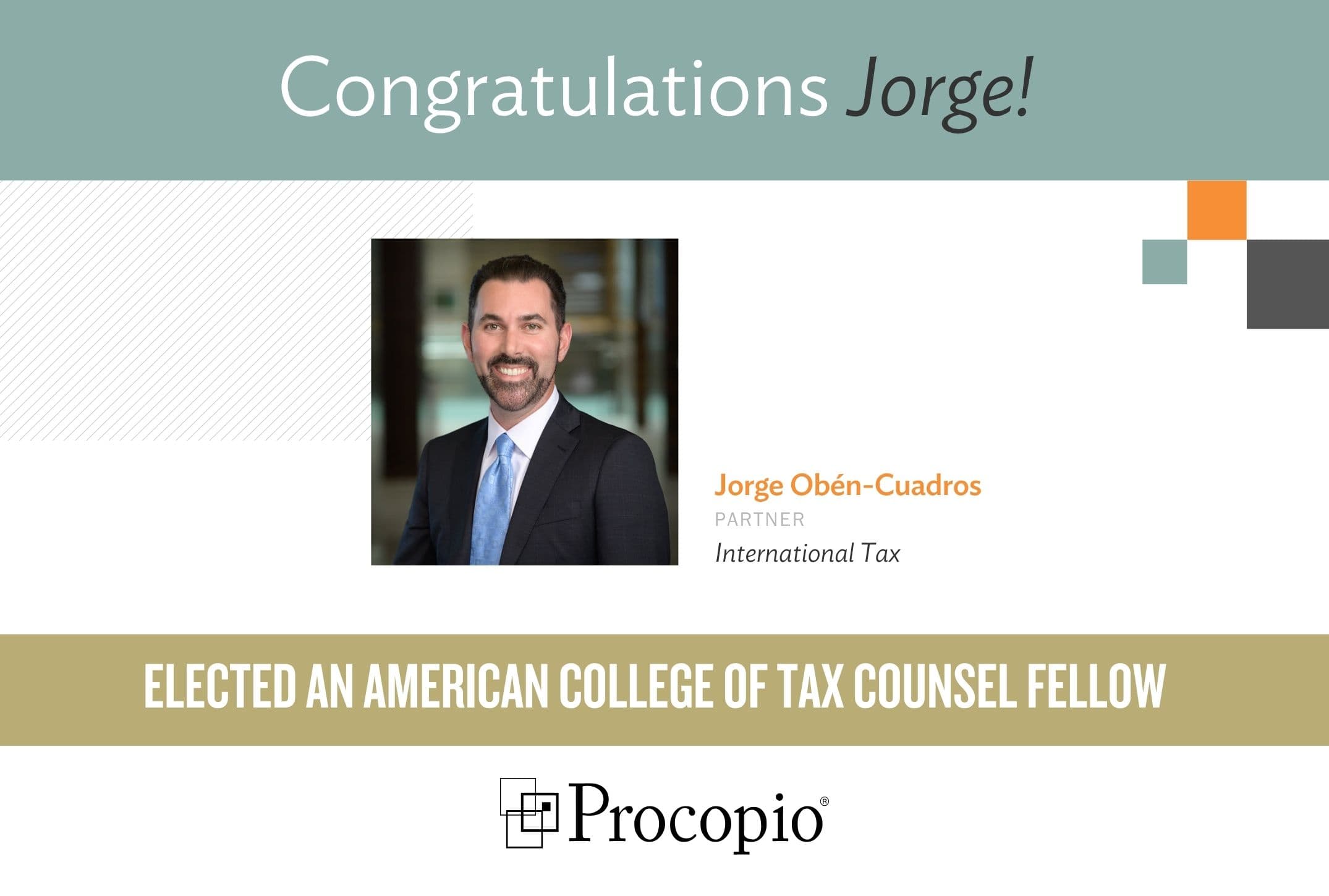
Jorge M. Oben-Cuadros
Jorge advises multinational companies, investment funds, family offices, and high-net-worth individuals on U.S. and international tax matters. Drawing on his private-practice and government experience, Jorge helps clients navigate cross-border tax planning, disputes, and policy developments with a practical understanding of how tax rules are developed, administered, and enforced.
His practice focuses on cross-border structuring, international tax planning and controversy, inbound and outbound investment, and strategic counseling on legislative and regulatory developments affecting global operations. He also advises clients on selected trade matters that intersect with their tax and cross-border business planning, with particular experience involving Latin America, Puerto Rico, and Europe.
Before joining Procopio, Jorge advised clients on cross-border tax planning and controversy matters. Earlier in his career, he served in the IRS Office of Associate Chief Counsel (International), where he drafted significant published guidance, including regulations implementing the Global Intangible Low-Taxed Income (GILTI) regime under Section 951A, and advised the IRS, the U.S. Department of the Treasury, and taxpayers on international tax issues. He also served as an IRS detailee to the U.S. House Committee on Ways and Means, where he worked on international and corporate tax legislation, Puerto Rico and U.S. territorial tax matters, trade-related tax issues, and energy provisions of the Inflation Reduction Act of 2022.
Stay up-to-date with the Procopio newsletter.
Sign Up NowMEDIA CONTACT
Patrick Ross, Senior Manager of Marketing & Communications
EmailP: 619.906.5740
EVENTS CONTACT
Suzie Jayyusi, Senior Marketing Coordinator Events Planner
EmailP: 619.525.3818
LATIN AMERICA CONTACT
Francisco Sanchez Losada, Marketing and Client Relations Manager
EmailP: 619.515.3225
ASIA PACIFIC CONTACT
Sanae Trotter, Senior Manager for Client Relations
EmailP: 650.645.9015